Porky Pig
I Haven't Got a Hat (1935) was the first Merry Melodies cartoon including Porky Pig, designed by Bob Clampett, and produced by Fritz Frelang. He was originally voiced by Joe Dougherty, then later by Mel Blanc. This cartoon was quite funny, and a has a lot of gags in it, however I don't think the characters were that original at this point in time, and the voices are actually quite annoying.
Bugs Bunny
After Porky Pig, Bug Bunny was designed by Cal Danton, then later modified by Tex Avery, then Robert McKimson. He is arguably the most famous Warner Bros character, or certainly for me he is the first character I think of when Warner Bros is mentioned. He is a very anthropomorphic rabbit, whch is what makes him so understandable and funny.
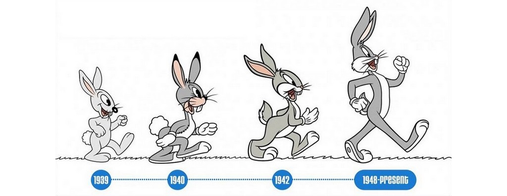
Bug Bunny's first appearance was in 1938 in Porky's Hare Hunt. Although the rabbit character doesn't look or sound like the Bugs Bunny we know today, it is a very early design of him. He is more recognisable by his cheeky attitude, which hasn't really changed much, as that's where his charm comes from, but I am glad they developed his design since his current design is much more interesting and creative.
Bugs Bunny then appeared in many other Looney Tunes shorts and finally got his own Merrie Melodies cartoon in 1940 called A Wild Hare, also starring Elmer Fudd, another one of Warner Bros' characters. Here Bugs Bunny's design has been updated, but is still not quite the same as it is today, however he has started to sound more like the modern day Bugs Bunny. He has also adopted his well-known catchphrase "what's up doc?".
Bugs Bunny then appeared in many other Looney Tunes shorts and finally got his own Merrie Melodies cartoon in 1940 called A Wild Hare, also starring Elmer Fudd, another one of Warner Bros' characters. Here Bugs Bunny's design has been updated, but is still not quite the same as it is today, however he has started to sound more like the modern day Bugs Bunny. He has also adopted his well-known catchphrase "what's up doc?".
Daffy Duck
Shortly after Bugs Bunny's first appearance, Daffy Duck made is his first appearance on 17th April 1937 in Porky's Duck Hunt. It was directed by Tex Avery and animated by Bob Clampett. In this cartoon, Daffy Duck looks very different to what he does now. He is now more anthropomorphic and he can also speak like a person as opposed to just quacking as he does in Porky's Duck Hunt. I prefer Daffy Duck as he is now because he is more distinguishable and memorable, whereas in the cartoon below he seems as if he'd more likely be an extra rather than later becoming a main character. This shows that he started off in a very similar way to Bugs Bunny.


