Using computers is the most common method of creating animation today, so this post is about the history of the computers which make animation possible today.
The first method of being able to draw into a computer system was Ivan Sutherland's Sketchpad (1961-62). It worked by the artist drawing onto a window with the required pen, then pressing buttons to alter the drawing to look as the artist wants it to.
Around the same time as Sutherland's Sketchpad, Steve Russel developed the first video game - Space War (1961-62). The object of the game is to shoot the other player's space ship without being sucked into the vortex in the middle of the screen. This should not be confused with two previous games which were made before Space War. These are OXO (1952) and Tennis for Two (1958). These are not considered video games, but are electronic games do to the fact they do not display by a process of frame-by-frame video. Tennis for Two is shown in the video below.
In 1968, Douglas Engelbart finished developing the NLS, the first online system. It was a huge leap forward in the world of computer graphics, with many never-seen-before features demonstrated, such as the first ever cimputer mouse.
In 1982, the Xerox Star Interview Interface was released. It was a more developed, and easier to use, version of the NLS.
The Xerox Star System was the influence for the personal computers from Windows and Apple that we have today.
France was always very advanced in their skills in cinematrography. Tn the late 19th century, the Lumiere brothers were the first to invented a system for capturing, processing and projecting moving images; in 1895.
Pauvre Pierrot (1892) by Emile Reynaud is an early example of French animation, and a very early depiction of colour. Little details, such as having a shadow when the characters come through the walls, adds to the style, making it look a little better. However, I personally don't like this animation; I find it boring because it's hard to work out what's actually happening, and to be honest it's not actually that well animated. I also don't like the character design particularly.
Emile Cohl's Fantasmagorie (1908), which has already been posted previously in the blog, is another early example of French animation which has been greatly influential across many cultures. Emile Cohl's real name was Emile Eugene Jean Louis Courtet, and he was inspired by Blackton. He also invented the black-line technique in animation.
Le Roman de Renaud (The Tale of the Fox) by Ladislaw Starewicz, was made in 1930 and was the first French feature animation. It was originally silent so the sound was added later. It is a stop-motion animation but displays very smooth animation and accurate comic timing, especially for an animation of that time period. The characterisation also has a great deal of personality and the characters' appearances are very interesting. Overall it is actually a very entertaining film to watch and is a perfect example of why French animation is so well renowned.
The above animation is Barbe - Bleue (Blue Beard); a stop-motion made in 1935 by Jean Painleve. Although it is an early animation, it is not particularly well animated for the time, and the intention seems to be to use a weird storyline and a fairytale design to distract from the poor animation. I found this animation a bit boring because it's not easy to understand the storyline, and it looks a bit of a mess to me.
L'epouvantail (The Scarecrow) was made in 1943 by Paul Grimault. I like this animation because the storyline is easy to follow so you understand it even if you don't speak French. It is also a very similar style to that of Disney's early series of cartoons, Silly Symphonies. It Grimault has included an amount of subtle humour which keeps the audience interested and entertained.
La Demoiselle et le violoncelliste (The Lady and the Cellist) (1965) by Jean - Francois Laguionie has a very interesting style as it all looks as though the animation is taking place in a painting. It is a collage animation so is most likely made using cutouts. The music fits very well with the mood emitted by the ocean and goes along with the events of the storyline. Whilst I like the style, I found the storyline dragged on a little too much, but I do think it has a nice resolve.
Asterix le Gaulois (Asterix the Gaul) was made in 1967 by Ray Goossen, and is a cartoon adaptation of Rene Goscinny and Albert Uderzo's comics. This movies is well-animated on the whole, and has a lot of humour, making it a fun movie to watch.
Les Tripletts des Belleville (The Triplets of Belleville) (2003) by Sylvain Chomet contains very smooth and realistic animation, whilst the design of the characters are very surreal but believable. I find their design original but at the same time I find them quite creepy, especially the waiter. However, the amazing animation and interesting storyline make up for this and is, overall, a great film. The animation technique is also very interesting as a mixture of 2D and 3D is used.
Persepolis (2007) is a feature animation by Marjane Satrapi and Vincent Paronnaud. It follows Marjane's life through the Iranian revolution. I watched this film all the way through and I loved it. The animation and style is so simple but effective, and works really well with the film being mostly in black and white. I also really like the story because it has its emotional moments, as it's so believeable due to it being a true story, but also has a lot of humour so is really fun to watch.
Sylvain Chomet's The Illusionist (2010) is one of the most well-animated film I have ever seen. The attention to detail is incredibly accurate, and the storyline is believeable and interesting to watch. I also really like the desgin because it contains a lot of detail and accuracy, but in a cartoony way. The colours are also really nice, because they are bright, but at the same time they are subtle and classy.
This animation by Katsudo Shashin (1907) is one of the earliest examples of Japanese animation. It has a great attention to detail in that the child takes the time to turn his head towards the audience, and the animation is very smooth, so it is possible that this is partially rotoscoped. It has a nice simple design.
Many of the early Japanese animators were largely influenced by Emile Cohl's Fantasmagorie as it was often set up for viewing in private screenings. A group of young artists who were particularly influenced by Cohl's work set up an animation studio called the Natural Colour Moving Picture Company.
Imokawa Mukuzo Genkanban no Maki (The Story of the Concierge Mukuzo Imokawa) was driected and drawn by Oten Shimokawa, a member of the Natural Colour Moving Picture Company, in 1917. The animation is very smooth, and gives off a sort of "classic Disney" vibe. It works very well in black and white as it gives it a very "world-war time" look. From the use of the animals as characters it is easy to tell this film is aimed at young children, however I don't like when it close-ups on their faces and they look a bit creepy; scares me a bit.
Namakura Gatana (Dull sword) was made by Seitaro in 1917. This animation has good strong design, and again is very smoothly animated, particularly the bit where the guy on the right gets kicked away by the guy on the right; it is likely that that bit is animated using cut out animation. The only real flaw with this animation is that it isn't very clear exactly what is happening at the beginning.
Experimental animation is an art-based form of animation and is mostly concerned with exploring new techniques, most commonly in the form of abstract animation. Abstract animation is a form of animation which explores the use of non-figurative forms and movement.
Hans Richter's Rhythmus 23 (1923) is an early example of abstract animation. It has no narrative and pretty much consists entirely of squares changing shape and size and is entirely in black and white. I personally think this animation is boring to watch because nothing exciting really happens and the colours are very dull. It is however, interesting to try to figure out how this animation would have been achieved in 1923.
Oskar Fischinger's Toccata and Fugue in D minor (1940) (above, top) and his Early Abstraction (1950) are also early examples of experimental animation. Early Abstraction is far more abstract than Toccata. Toccata is part of Disney's Fantasia (1940), so the animation fits the music in a more classic, semi-abstract way. However, after watching Early Abstraction, it is arguably evident that the latter animation actually fits its music better as it uses bolder and brighter colours, and the visuals correspond with the beat more accurately. However, despite this I prefer Toccata as the style used in the animation is more varied throughout so I find it makes it more interesting to watch.
Early Abstractions (1946) by Harry Smith is also an abstract animation, though not as early as some of the previous examples. It is far more dynamic than some of the earliest examples, making it more interesting to watch. It also sticks to the concept of cells, shown by many of the shapes; and the movements of the shapes look as though they are splitting like cells under a microscope. The colours used are also very natural, and the music sounds quite organic, which sticks to this kind of natural science style within the animation.
A Colour Box (1935) (above, top) by Len Lye, is an animation which was made for G.P.O (now called Royal Mail) as a piece of advertising. It is lively and doesn't take itself too seriously, so it's quite a bold and fun animation to watch; especially when coupled with the lively music. However it is a bit weird when, towards the end, it starts advertising the various prices of sending a parcel, it almost ruins it really. Rainbow Dance (1936) by Len Lye was also produced by G.P.O. Again, it is very lively and fun to watch and uses bright colours and fast-paced music. However, it is less abstract, and the fact that a dancer is used as a central subject, it gives the viewers eyes something to follow, and a little more narrative, rather than allowing your eyes to flit around the screen like in his previous animation.
Boogie Doodle by Norman McLaren is another example of abstract animation, again to lively, fun music. I like this animation better than the previous examples of abstract animation because the style is more interesting in that adding the white and black marks to the blue shapes gives them a more 3D look, which contrasts really nicely with the 2D looking black marks. Also, because the animation focuses on just a couple of central shapes, it gives the viewer's eyes something to focus on as opposed to just flailing around the screen. Neighbours (1952) by Norman McLaren is an example of experimental animation which is not abstract, and it also has a storyline. This animation has also been done using stop-motion, which was less common in early experimental animation. This animation really works though because it is clearly using real actors, but gives a very comical look to it, and certain points in the animation happen which would have never been possible in live action, such as when one of the characters is flying.
Tango (1983) by Zbig Rybczynski is an experimental animation about the chaos of life, where the increasing number of people in that one room builds up a sense of anxiety, but the routine and repetition in it makes it easy to cope with the amount of information happening at once in this animation. It is a great animation to watch, really original, and one of the most fascinating things about this animation is it's impeccable timing and coordination; a really great animation.
The UPA, previously called The Screen Cartoonists Guild, was formed in 1938 by a group of animators who had previously quit Disney Studios as a result of a strike regarding the lengthy processes they had to go through to create their animations. However, their style was different to that of Disney's, namely it was more simple and stylised; often think-lined. They also used distorted perspectives and a strong use of story and voice. Limited animation is also used to reduce the amount of drawings used to make the animation, so therefore the cost reduced as well.
The Dover Boys of Pimento University (1942) is a Merry Melodies cartoon, directed by Chuck Jones. It is an example of how the UPA used limited animation in their cartoons. This is evident by the fact there are a number of places in the cartoon where backgrounds are shown with no moving character in front of them for a longer amount of time than would normally be used. It is also very noticeable when the woman, Dora Stanpipe, walk down the stairs in her house and just slides along the floor as opposed to having any kind of walk cycle, which I did find a little irritating, but it was still funny in a way. Despite the animating on the cheap, the cartoon still works as a whole because of its strong use of story and the humorous gags it pulls out; especially when Dora Stanpipe is screaming for help, but at the same time is quite ably beating up her kidnapper.
The Magic Fluke (1948) is another early example of UPA's limited animation. In this cartoon, the limited animation is far less evident than in The Dover Boys of Pimento University, however it is also less funny, although the story is still very strong.
Gerald McBoing Boing (1951) is a great example of how using limited animation can be very effective, and is one of UPA's most famous series. The characters are very simple and stylised, and the backgrounds are not fully drawn in, but I think it actually gives a really nice atmosphere and style to the cartoon. The story to the cartoon is pretty cute, which matches the simple, cute style of the characters and backgrounds. The limited pallet of colour also works great because the colours used are all mostly neutral and therefore they go together well; the fact that parts of the background and characters are not coloured in only adds to the charm.
Mr Magoo (1949) is another of UPA's most famous animated series. Like Gerald McBoing Boing, this cartoon has partly coloured-in backgrounds, again adding to this original style. This also has a very simple concept, which matches the simple style and makes it easy and light-hearted to watch.
Tex Avery started off animating at Walter Lanz Studios in the early 1930s, then in 1935, he moved to Leon Schlesinger Productions where he ran a production unit with Chuck Jones and Bob Clampett. Their studio was nicknamed "Termite Terrace" and Avery worked with many famous characters such as Elmer Fudd, Porky Pig and Daffy Duck; the building has now been demolished. Avery then moved to MGM studios in 1941, following a dispute with Schlesinger where at the end of The Heckling Hare Bugs Bunny and Hunting Dog fall off a cliff three times, but before the third fall they were to look at the audience and Bugs says "hold onto your hats, folks, here we go again", which was the ending line of a well-know porn sequence at the time. During Tex's time working at MGM with Fred Quimby, he began to push gags to the extreme to a point where they became very surreal and out-of control.
Red Hot Riding Hood (1943) is a great example of Tex's out-of-control style. This cartoon is clearly quite frantic, and the gags are pushed to the extreme but that really does work as part of the gag, such as when the wolf turns into a car, and when the granny goes flying because the wolf stuck a pin in her back side. The set-up for the latter joke is very clever because you don't actually see the pin stab her bum, but you see the pin and her bum then you see her in pain so you know exactly what has happened. The comedy in this is very aggressive, in-your-face, and not child-friendly but it is incredibly funny. It's also an original take on little red riding hood which makes it a bit more interesting.
Ventriloquist Cat (1950) is an example of how Avery used exaggerated body capabilities to create humour, such as the dog being able to survive having his insides blown up again and again and still being able to recover. It is also an example of using repetition to make things more funny. This is a classic cat and dog fighting cartoon, but the way the cat tries to injure the dog are quite original so it's still funny.
Bad Luck Blackie (1949) is very similar to Tom and Jerry, on which Avery also worked. It is another great example of how repetition can be used as a gag, namely everytime the black cat walks past the dog, something falls on the dog's head. Again, this is a classic cat and dog cartoon but by pushing the gags to the limit it continues to be funny.
Tom and Jerry
Tom and Jerry is a cartoon with a simple storyline about a cat (Tom) and a mouse (Jerry), involving surreal injury gags, usually at Tom's expense. Tex Avery's influence in this cartoon series is greatly evident by the comically violent nature of the characters towards each other.
Puss Gets the Boot (1940) is an early example of Tom and Jerry. Even though the cat in this cartoon is called Jasper, from looking at the design it is easy to tell that this is an early design of Tom. It also shows that Jerry's design has mostly remained the same throughout the years. Even though it is funny to watch, I almost feel as though it's a bit irritating to watch because the lady calls Tom "Jasper" whereas I know him as Tom so it seems a bit strange.
The Little Orphan (1949) is a great example of how the crew working on Tom and Jerry really use the musical score to make the fighting funny and light-hearted. They also use the story behind thanks giving as the concept for Tom and Jerry's fighting.
The later Tom and Jerry cartoons (directed by Gene Deitch at Rembrandt Films, then later by Chuck Jones) were successful but not as critically acclaimed as the early ones. The Tom and Jerry Cartoon Kit (1962) is a later cartoon, and it really doesn't have the same charm as the earlier cartoons.
After Hugh Harman and Rudolph Ising left Leon Schlesinger Productions in the 1930's, Looney Tunes and Merry Melodies cartoons were continued to be made and distributed by Warner Bros, who eventually bought them in 1944.
Porky Pig
I Haven't Got a Hat (1935) was the first Merry Melodies cartoon including Porky Pig, designed by Bob Clampett, and produced by Fritz Frelang. He was originally voiced by Joe Dougherty, then later by Mel Blanc. This cartoon was quite funny, and a has a lot of gags in it, however I don't think the characters were that original at this point in time, and the voices are actually quite annoying.
Bugs Bunny
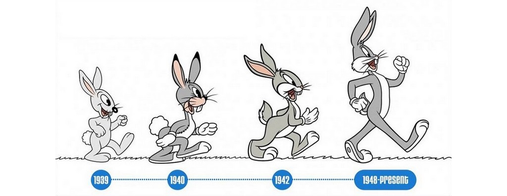
After Porky Pig, Bug Bunny was designed by Cal Danton, then later modified by Tex Avery, then Robert McKimson. He is arguably the most famous Warner Bros character, or certainly for me he is the first character I think of when Warner Bros is mentioned. He is a very anthropomorphic rabbit, whch is what makes him so understandable and funny.
Bug Bunny's first appearance was in 1938 in Porky's Hare Hunt. Although the rabbit character doesn't look or sound like the Bugs Bunny we know today, it is a very early design of him. He is more recognisable by his cheeky attitude, which hasn't really changed much, as that's where his charm comes from, but I am glad they developed his design since his current design is much more interesting and creative.
Bugs Bunny then appeared in many other Looney Tunes shorts and finally got his own Merrie Melodies cartoon in 1940 called A Wild Hare, also starring Elmer Fudd, another one of Warner Bros' characters. Here Bugs Bunny's design has been updated, but is still not quite the same as it is today, however he has started to sound more like the modern day Bugs Bunny. He has also adopted his well-known catchphrase "what's up doc?".
Daffy Duck
Shortly after Bugs Bunny's first appearance, Daffy Duck made is his first appearance on 17th April 1937 in Porky's Duck Hunt. It was directed by Tex Avery and animated by Bob Clampett. In this cartoon, Daffy Duck looks very different to what he does now. He is now more anthropomorphic and he can also speak like a person as opposed to just quacking as he does in Porky's Duck Hunt. I prefer Daffy Duck as he is now because he is more distinguishable and memorable, whereas in the cartoon below he seems as if he'd more likely be an extra rather than later becoming a main character. This shows that he started off in a very similar way to Bugs Bunny.